The Whiskey Rebellion
by Richard R. Wilt
Insurrection of the farmers of Western Pennsylvania.
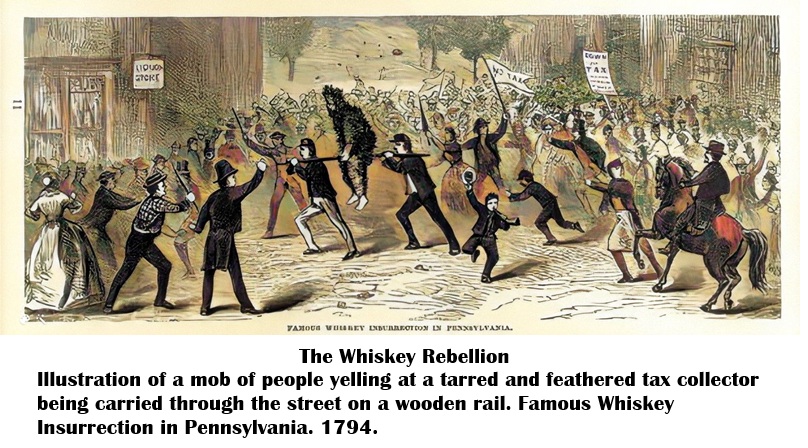
I have an interest in the Whiskey Rebellion due to having two ancestors who served or were scheduled to serve during that time of the Revelation War which was financed on credit and the Continental Congress was trying to raise money to pay the debt. Previously taxes were placed on spirits at the retail or tavern level and the congress had decided to tax spirits (whiskey) at the farm or production of the spirits. The farmers, of course, were in opposed strongly saying farm products should not be taxed at the source.
Stephen Stiles (1738–1819) was a Revolutionary War Sergeant born in Hanover, Morris County, New Jersey, on September 5, 1738. He served in the 5th Company, 1st Battalion, Washington County, Pennsylvania Militia under Captain James Archer from 1780 to 1783.
Captain James Archer commanded the 5th Company of the 1st Battalion, Washington County, Pennsylvania Militia during the American Revolutionary War, active around 1781–1782. His company was recruited in Cumberland Township, which is now part of Greene County, Pennsylvania.
Records from 1782 list him leading a company that included Stephen Stiles, who served as a sergeant under Archer. Archer's unit part of the local militia responsible for defense and security in western Pennsylvania during the war.
Prior to the Revolution Stephen married Lydia Taylor (c. 1744–1763) having two sons. Job (1760-1841) and Arron (1761-1843) After the death of Lydia, Stephen gave his two sons to his brother, (Capt. John Stiles) and migrated to western Pennsylvania.
Here he meets and marries Bethena (1740-1800 possible last name of Cross) in Bedford, County Pennsylvania were his third son, William (1770-1852) was born.
Stephen remained in service as most militia members did, but also returned and worked his farm. During this time Stephen sold his farm in Green County, Pennsylvania and bought 1000 acres in Monongalia County, VA (WV). He and Bethena's second child was born in Wana, VA in 1797.
He and Bethena had nine children. Stephen Stiles died in Wana, Monongalia County, West Virginia, on May 5, 1819, and is buried in Crossroads Cemetery #1.
Stephen was reactivated in 1794 to serve during the tax disturbance in Western Pennsylvania
Peter Wilt born: February 15, 1775 - 1825
Peter Wilt is probably the person of that name whose military service record shows that he was slated to march from Virginia to fight against insurgents in southwestern Pennsylvania in 1794. This action became known as the Whiskey Rebellion. Peter's record shows that he became ill during the march to Pennsylvania and was left behind. He was given three months pay for the period September 1 to December 1, 1794. The record shows that prior to his discharge, Peter served under the command of Ensign William Clark. (It is highly likely that this was the same William Clark who would later gain fame for his leadership role in the Lewis and Clark expedition, which explored the western half of America from 1804 to 1806. It is known with certainty that this William Clark was an officer in the Whiskey Rebellion.) Previously, Peter had served under Col. William Campbell's Regiment of Virginia. Peter was paid $3 per month.
In August 1795 Peter Wilt was named as a member of his stepfather Jacob Beavers' household in Loudoun County, Virginia. By the end of that decade, Peter had moved to Truro Parish, in adjacent Fairfax County. At the time, Truro Parish encompassed the southern half of Fairfax county.
The Whiskey Rebillion
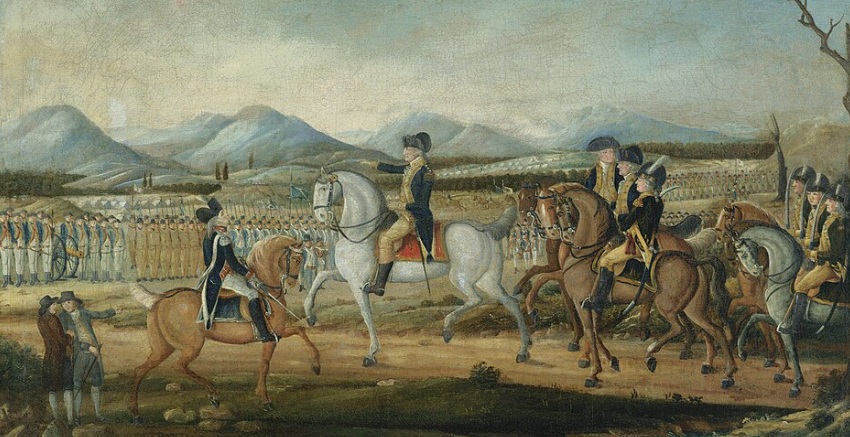
Washington and the Troops march west
It all started with a tax. What came to be known as the Whiskey Rebellion of 1794, or the Western Insurrection, took place over a period of time beginning in 1791 by most accounts. While some would say the roots go back much further, it was not until March 3, 1791 that Congress instituted an excise tax on distilled liquors that set the rebellion of 1794 in motion.
What was the root cause of this rebellion?
The western part of Pennsylvania at this time was separated from the east by the Allegheny Mountains. With the majority of the population being farmers, there was often a limited market for the sale of their grain locally and it was difficult to transport the grains to the east for sale. The goods had to be transported by pack horse over the mountains and along dirt roads and the horses could only carry limited amounts at a time. Converting the grain to whiskey made it more transportable and there was a better market for this product.
Having assumed the debts of the colonies from the Revolution, the government found itself deep in debt. In 1791 Congress approved a bill putting an excise tax on all distilled spirits. The tax, based on the capacity of the still rather than the quantity produced, was required to be paid in cash - something unusual for the time as whiskey was often the monetary unit westerners used to pay for their goods and services - not cash. The tax for the smaller producers was required to be made throughout the year and their cost was about nine cents per gallon. The large producers in the east took less exception to the tax, their cost to get the goods to market was less and they could decrease their tax by increasing their volume, something the farmers in the west were not able to do. They were also able to make annual payments for the tax that amounted to six cents per gallon.
Already at odds with the government with regard to Indian attacks, the farmers felt that this interference into their business was unjust and encroached upon their rights. A meeting at Redstone Fort in July of 1791 began the organized resistance to the collection of the excise tax. Many of the westerners refused to pay the tax and those coming to collect the tax were often ambushed or humiliated, some were tarred and feathered.
Violence continued to escalate and spread to other counties over the next few years. President Washington's proclamation, in 1792, condemning interference with the "operation of the laws of the United States..." did not calm matters.4 Despite appeals for a peaceful resolution, a militia gathered at Braddock's Field during the last week in July 1794. On August 7, 1794 the President issued another proclamation calling for the rebels to disperse and return to their homes as well as invoking the Militia Act of 17925 which allowed the President to use State military (militiamen) to put an end to the rebellion.
Approximately 13,000 militiamen from surrounding states marched with President Washington to put down the rebellion. While no real battle ensued, about 150 rebels were arrested. Most were released due to lack of evidence, 2 were convicted of treason and then later pardoned.
Why was this rebellion significant in our history?
The Whiskey Rebellion was the first test of federal authority in the United States. This rebellion enforced the idea that the new government had the right to levy a particular tax that would impact citizens in all states. It also enforced the idea that this new government had the right to pass and enforce laws impacting all states.
Return to My Stories Index
|